Apis mellifera mellifera — the bee for challenging seasons
Greetings to all beekeepers and bee friends!
At SIA “Smilga Spalviņa”, we have been keeping and breeding the European dark honey bee, Apis mellifera mellifera hereinafter — A. m. mellifera for the fourth year now, so I would like to share my experience with this unique bee race Figure 1.
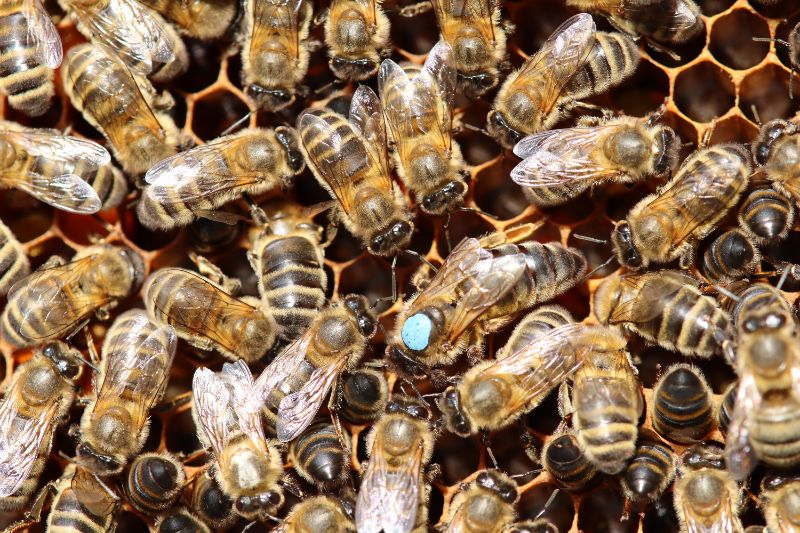
Figure 1. A. m. mellifera queen bee with worker bees.
Over the years, our beekeeping operation has introduced and carefully selected a very diverse range of breeding material from different bee races, including Carnica, Ligustica, Carpatica, as well as inter-race crosses such as Buckfast and Carnica–Carpatica. We maintain several commercial lines for each race and cross. Therefore, at first it seemed that we had gained sufficiently broad experience and that nothing would fundamentally surprise us anymore. However, it must be admitted that the arrival of the European dark honey bee in our apiaries completely overturned this belief.
Challenges in finding A. m. mellifera breeding material
Our wish to obtain A. m. mellifera breeding material arose seven years ago, when we began working with breeding and instrumental insemination. At first, we tried to find out who might have A. m. mellifera material available in Latvia. Through the Latvian Beekeepers Association, we obtained contacts and reached out to several beekeepers, but we did not receive any real responsiveness or willingness to share breeding material. We assume that for some Latvian beekeepers who may previously have had pure A. m. mellifera colonies, this material has been lost over time, or its quality is no longer suitable for propagation and distribution. The limited availability of A. m. mellifera in Latvia is also shown by the fact that SIA “Smilga Spalviņa” is the only queen-breeding operation in the Baltics where A. m. mellifera queen bees are publicly available for any beekeeper to order.
After approximately two years of searching among local beekeepers, we understood that this breeding material was practically unavailable in Latvia. Therefore, we began searching outside Latvia. It quickly became clear that the availability of A. m. mellifera elsewhere in Europe is also very limited. Over several years, we contacted beekeepers from Finland, Sweden, Norway, Germany, Ireland, and the United Kingdom, but finding pure-bred A. m. mellifera breeding material was not easy. The reasons varied. Sometimes a beekeeper offered only virgin or naturally mated queens, from which it is not possible to reproduce pure A. m. mellifera material. In other cases, the beekeeper had only one breeder queen and raised queens from her only for their own needs or for a narrow circle of acquaintances. There were also cases where the beekeeper honestly admitted that they were not fully confident about the purity of their A. m. mellifera material. Additional obstacles were created by foreign beekeepers’ lack of experience in sending queen bees, unfamiliarity with veterinary certificates and the TRACES NT system, as well as unwillingness to share their breeding material outside their own country.
We also contacted SICAMM, the international association for conservation of A. m. mellifera, and expressed our wish to become a member. After prolonged communication, we understood that in 2023 and 2024 SICAMM, as an organization, was undergoing significant internal changes and transforming into a more formal membership organization, and therefore at that time it could not help with contacts. However, from 2026 we have officially become an individual member of SICAMM. Continuing this cooperation, we hope that in the future the circulation of A. m. mellifera breeding material will become more accessible, simpler, more transparent, and more predictable.
After a long search, in 2023 we finally found contacts from whom we could try to purchase A. m. mellifera queen bees.
A. m. mellifera from Norway. In spring 2023, we contacted an acquaintance in Norway, who was very responsive and, in his native language, tried to arrange the purchase of A. m. mellifera both from local beekeepers in Norway and Sweden. Since this acquaintance had no knowledge of beekeeping, arranging controlled-mated A. m. mellifera queens through him became quite an adventure in itself. In the end, he managed to find more open beekeepers who had isolated queen mating stations in southern Norway. Since these beekeepers were engaged in commercial queen breeding, they were willing to sell six controlled-mated A. m. mellifera queens from different lines. Converted from Norwegian kroner, the cost of one queen was 350 euros.
Norway is not a member state of the European Union, so transporting animals, including queen bees, is much more complicated than within the EU, where it is possible to use certificates prepared by veterinary services in the TRACES NT system and courier services. Fearing that delivery and document coordination would take too long and that the queen bees might not survive the journey, we decided to go and collect them ourselves. So we got into the car and drove to Ventspils, took the ferry to Nynäshamn in Sweden, and then drove across all of Sweden to Halden in Norway, where the queen bees were waiting for us in a parcel locker at a supermarket. On the way, we had to explain to Norwegian border control who we were and what we were looking for in Norway. The anxiety and risk were high, because border control could have confiscated the queen bees and even fined us for attempting to take the material out of the country. However, after we showed the invoice for the queen purchase, we were allowed to continue our journey. Thus, after a continuous two-day trip there and back, we returned to Latvia with our first six A. m. mellifera breeder queens. All the queens were successfully introduced into colonies and began laying.
A. m. mellifera from Germany. In the second half of summer 2023, we managed to contact a beekeeper in Germany who was willing to sell us two instrumentally inseminated A. m. mellifera queens. Unfortunately, an unsuitable courier service was chosen, and the queen bees were held in warehouses in Germany for a week, after which they were sent to us through the standard postal system, which is very slow. This queen-shipping experience was full of anxiety for both sides. We were constantly worried, stayed in contact with our German colleague, and as the days passed, it became clear to both of us that the queens would most likely not reach us alive. In the end, the shipment arrived on the 15th day after dispatch. One queen, together with all the worker bees, had died, while in the second cage only the queen herself had remained alive — without even a crumb of candy left. Fortunately, we managed to successfully introduce this one surviving queen into a bee colony, and she began laying.
A. m. mellifera from Sweden. At the end of the 2023 season, I unexpectedly received a call from Valters Brusbārdis saying that A. m. mellifera queen bees had arrived at the LBB office from Sweden, and nobody knew anything about them. This was a very pleasant surprise, because thanks to Valters, five A. m. mellifera queens from Sweden, mated at an isolated station, came to us. Once again, thank you to Valters Brusbārdis and LBB!
Thus, after a long search, within one season we obtained A. m. mellifera material from Norway, Germany, and Sweden. Since all queens were received at the end of July or in August, it was no longer possible to raise drones from them for instrumental insemination. Due to the lack of time, queens were raised and naturally mated only in limited numbers.
Beekeeping with A. m. mellifera colonies
Beekeeping with A. m. mellifera colonies differs greatly from working with other races. Therefore, here is a brief insight into what to expect from these colonies.
Overwintering. A. m. mellifera colonies overwinter excellently, with very low feed consumption. In spring, the winter feed has been consumed only minimally, mainly where the centre of the cluster was located. In winter, the bee cluster forms in the lower part of the combs, so during quick inspections from above it is difficult to see. Bee mortality is very low, the hive floors are clean, and even small units are able to overwinter and recover very well in spring. It should also be mentioned here that A. m. mellifera worker bees live slightly longer than worker bees of other races, are slightly larger in size, and also have higher vitality, which is certainly an advantage in surviving harsh winters and rebuilding colonies in spring. The downside, as with all colonies, is that if timely treatment against Varroa mites has not been carried out, the colonies may also fail to overwinter.
Behaviour. Overall, A. m. mellifera colonies are restless; the bees flow like water away from the combs together with the queen. Therefore, finding the queen is almost an impossible mission. If you work with the colony for a long time, you may suddenly realize that the combs are completely empty and all the bees have run onto the hive walls and floor, or even out of the hive. On the combs, the bees move very actively and create a kind of shimmering effect. Aggressiveness is considerably lower than I had expected. If one works quickly, the entire inspection can be carried out even without smoke and without stings. Of course, some individual colonies do require smoke, but even then, it is more about the formation of a very active cloud around the head rather than targeted stinging.
Productivity. Productivity depends on the season. For example, 2024 was a rich honey year with strong nectar flows. In such a productive year, A. m. mellifera colonies lagged behind all colonies of other races. The colonies were small, and the only nectar flow they used was heather. By contrast, in the poor, rainy 2025 season, A. m. mellifera colonies stood out with the highest nectar intake and complete self-sufficiency. The A. m. mellifera colonies were the only ones with beautiful rings of bee bread around the brood and even honey, while colonies of other races had to be fed in the middle of the season to prevent them from dying. A similar trend is also visible at the beginning of the 2026 season: the weather is cool and windy, and the nectar flow is weak, yet A. m. mellifera continues to develop without pause and supplies the brood nest with abundant pollen and fresh nectar, while the development of other colonies slows down somewhat. A. m. mellifera flies at lower air temperatures and also during very weak nectar flows. For the second spring now, I have observed that these colonies are the first to bring in willow nectar, while others still wait a couple more days. In a way, with its behaviour, A. m. mellifera acts as a messenger announcing the start of the nectar flow.
Swarming. The tendency to swarm is definitely greater than in other races; they will be the first to build swarm cells. Of course, in most cases swarming can be interrupted by removing part of the brood frames. But there are also some outstanding swarmers where even making an artificial swarm with the old queen did not help. For example, only the bees and the queen were left in the hive on foundation sheets, yet after two weeks they had still swarmed. In addition, nectar-flow and weather conditions that promote swarming help us observe and select A. m. mellifera colonies with a less pronounced swarming tendency.
Brood nest. I keep bees in Latvian standard hives (space of 15 Dadan-Blatt frames in brood level), so there is no shortage of space. A. m. mellifera colonies form a compact brood nest, meaning that on each comb they always allocate space for brood, then place pollen around the brood, and then nectar. The combs always look exactly as described in theoretical beekeeping books Figures 2 and 3. The advantage of such an arrangement is that the necessary resources are always located next to the brood, and the colony raises only as much brood as the available natural food reserves can support. A. m. mellifera also very much likes to use empty hive space. If the colony still seems relatively small and spare frames with undrawn foundation have been placed behind the divider board, then unnoticed, all the frames will be drawn out and the empty space filled with comb built entirely by the bees themselves, usually attached to the plastic sheet or hive cover.
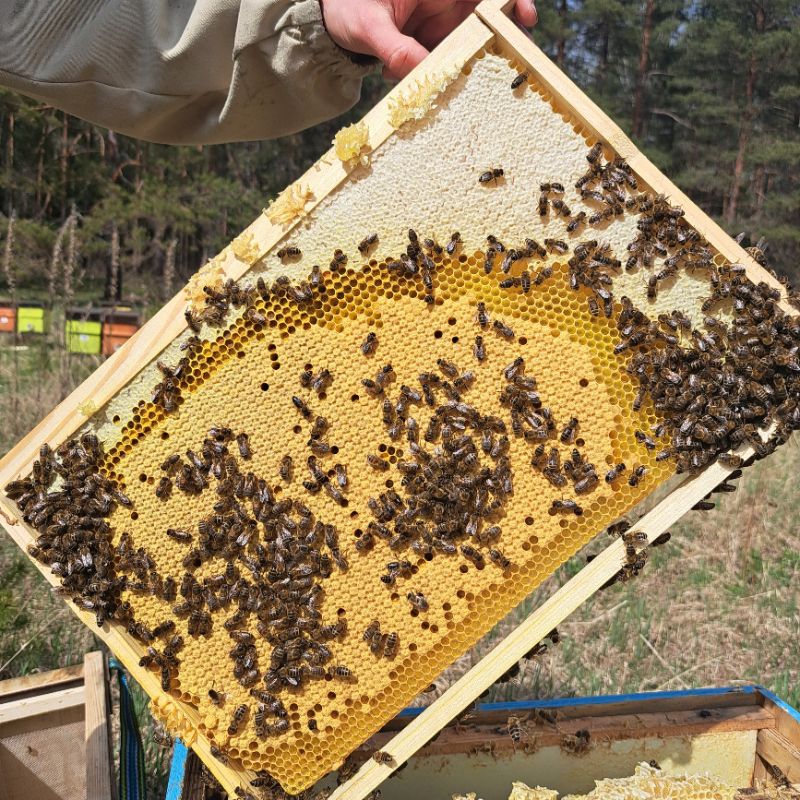
Figure 2. A. m. mellifera brood comb.
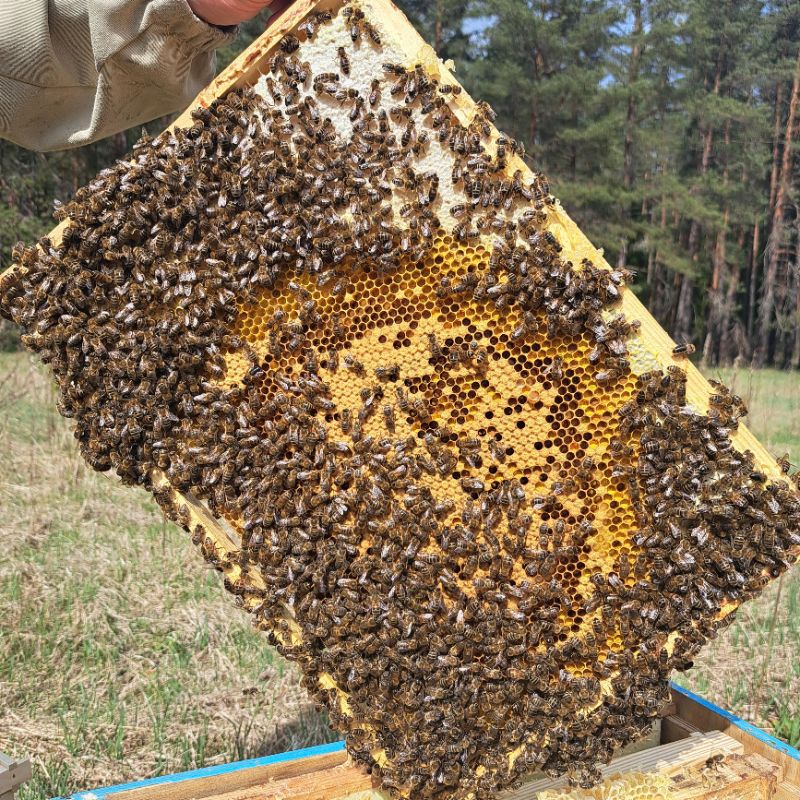
Figure 3. A. m. mellifera brood comb.
Overall, A. m. mellifera colonies have proven themselves to be excellent bees for poor forage years, demonstrating their self-sufficiency and ability to survive harsh, low-yield seasons. For commercial honey production, other races are certainly more convenient and productive. However, in breeding, A. m. mellifera definitely has many positive traits that are worth developing and introducing into other subspecies as well. An A. m. mellifera colony can certainly also be useful in small apiaries where recovery is needed after winter colony losses.
Despite the challenges in obtaining A. m. mellifera breeding material, we are very pleased that we have been able to get to know this bee race in our apiaries, preserve it and improve it with the help of instrumental insemination, and ultimately also offer other beekeepers the opportunity to introduce A. m. mellifera into their own apiaries.
Wishing everyone a productive 2026 season!
Published in the journal "Biškopis," 3rd issue of 2026, by the Latvian Beekeepers Association.
Cart
Cart is empty.